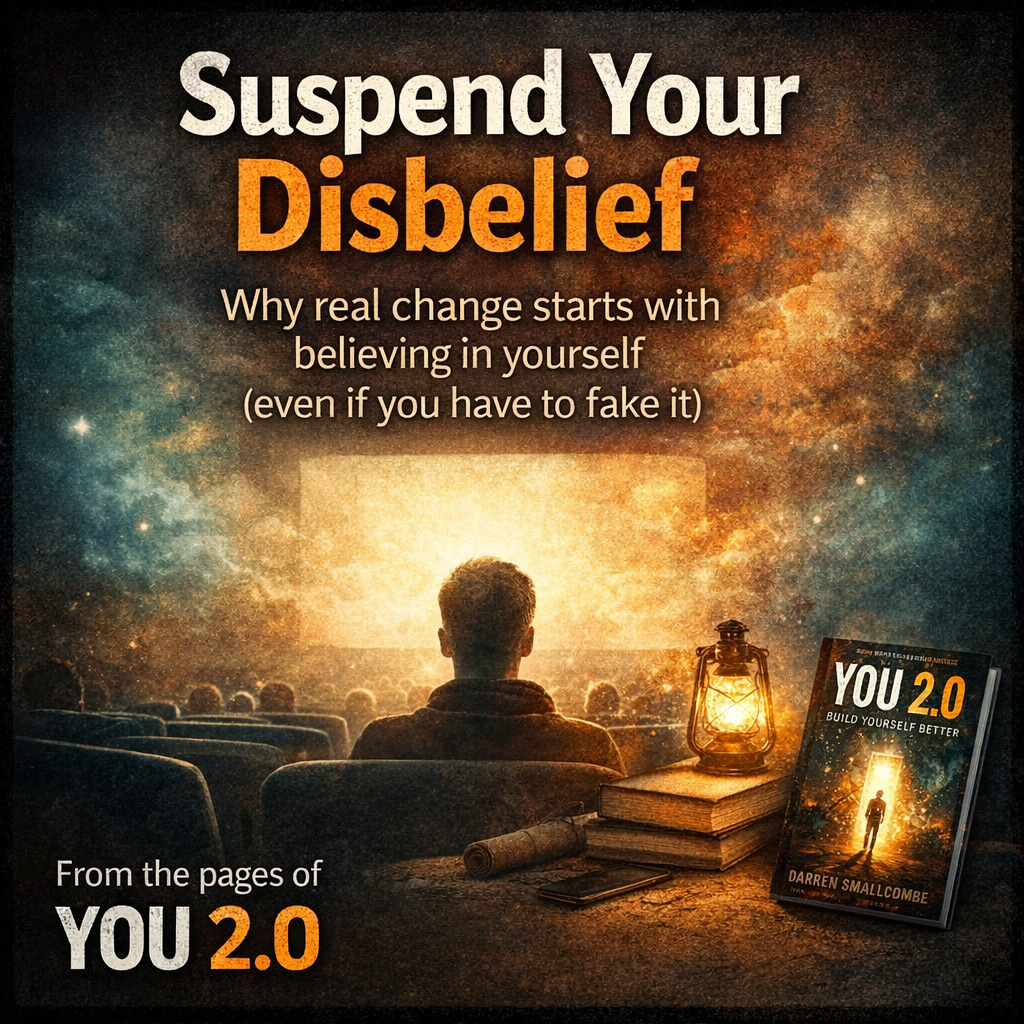
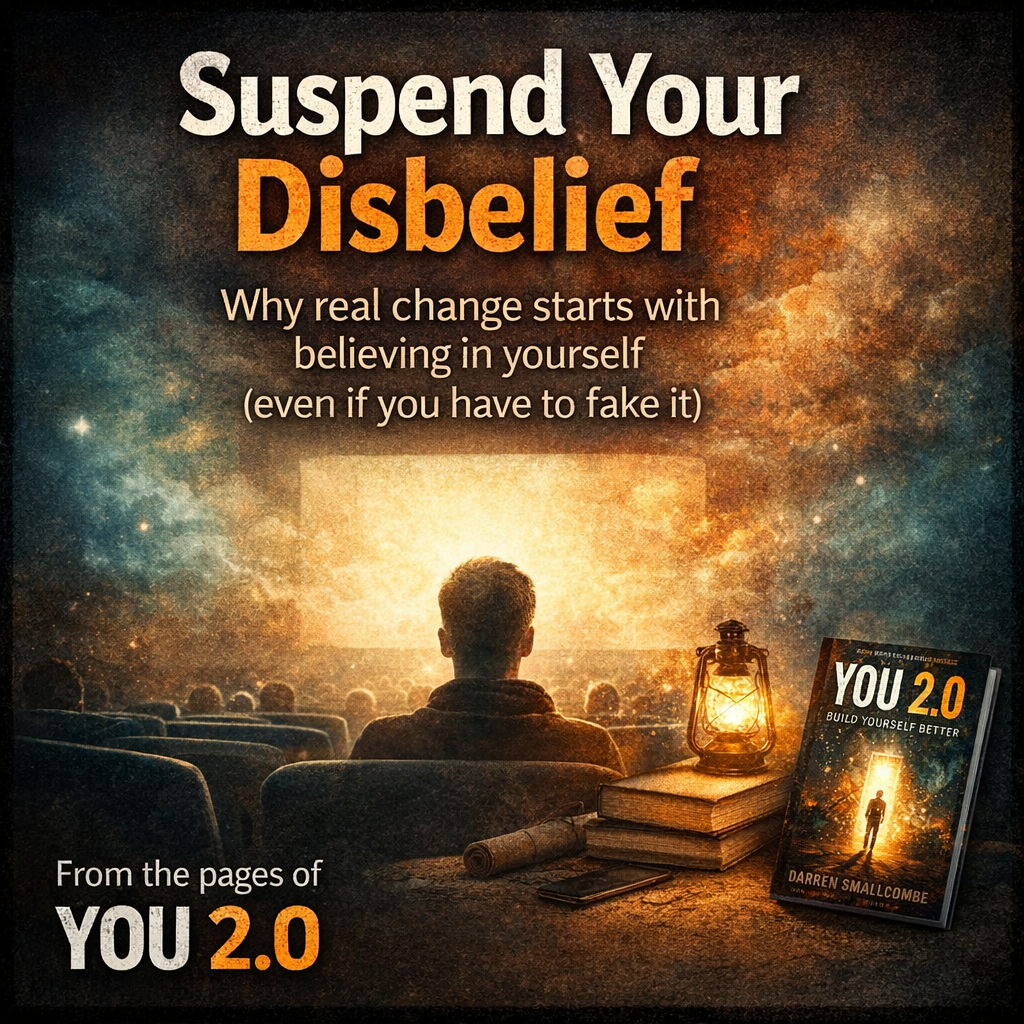
Suspend Your Disbelief Revisited: Why real change starts with believing in yourself (even if you have to fake it)
Have you ever been in a moment where everything just clicked?
Where you felt capable, confident, unstoppable — like you could handle whatever was thrown at you?
You might not remember it straight away, but keep digging. Somewhere in your life, at some point, you rocked.
So here’s the real question:
Why do so many of us spend the rest of our lives believing the opposite?
Why we remember failure more than success
Humans are what I call deletion creatures.
Our brains are flooded with information every second — from our senses, our emotions, our internal chatter. To cope, the brain filters ruthlessly. Most of what we experience is deleted.
Unfortunately, what tends to survive that filtering process isn’t our successes — it’s our mistakes.
Layered on top of this is something psychologists and coaches have talked about for years: the pleasure–pain principle.
At a deep level, we’re driven by two things:
avoiding pain
gaining pleasure
And here’s the uncomfortable truth: we will usually do more to avoid pain than to gain pleasure.
That’s why:
you didn’t ask that person out, even though you wanted to
you stayed in a job or relationship you knew wasn’t right
you didn’t apply for the better role, despite being capable
Your brain did the maths and decided the potential pain of rejection, embarrassment, or failure wasn’t worth the risk.
So fear whispers a comforting lie:
“You’re probably not that good anyway.”
And so… you don’t try.
The beliefs that quietly run your life
Beliefs aren’t just thoughts. They’re instructions your brain tries to obey.
Think you’re not good enough? Then your brain will work very hard to prove you right.
Think you can’t do it? Then you won’t.
Not because you’re lazy or broken — but because your brain doesn’t want to make you out to be a liar.
This is why belief change matters so much.
And it’s also why waiting until you feel 100% confident before acting is a trap.
Suspend your disbelief (just like at the movies)
When you go to the cinema, you already know the plot is ridiculous.
Bruce Willis doesn’t really take down terrorists barefoot. Jeff Goldblum didn’t actually upload a virus into an alien mothership.
And yet — for two hours — you suspend your disbelief.
You lean in. You accept the premise. You let yourself be entertained.
That same skill can be used in real life.
If you catch yourself thinking:
“I’m not confident enough yet” “I’m not ready” “I’m not that kind of person”
Try this instead:
Suspend the disbelief temporarily.
Act as if you were already the person you’re becoming — just long enough to take the next step.
You don’t need lifelong belief. You just need belief long enough to move your toe.
Cultivate your mental garden
Beliefs don’t exist in isolation.
They’re shaped — constantly — by:
the people around you
the language you hear
the stories you repeat to yourself
Think of your mind like a garden.
Left unattended, weeds grow fast.
Doubt. Self-criticism. Old labels planted by teachers, bosses, or well-meaning family members.
If you don’t actively choose what grows there, something else will.
The work, then, is simple (but not easy):
notice limiting beliefs when they appear
pull them out early
replace them with memories of success, effort, and progress
Then define — in detail — the person you are becoming.
How do they stand? How do they speak? How do they act under pressure?
And start practising being that person now.
Take a bite (a small experiment)
Try this:
Write down five times you felt genuinely confident — moments when you handled something well, persuaded someone, achieved a goal, or surprised yourself.
Capture the details:
what you were doing
how you felt
how you stood or breathed
Fold the list up. Keep it with you.
Any time anxiety shows up, read it.
Evidence beats opinion — even your own.
Belief isn’t enough (but it’s the start)
Let’s be clear: belief alone won’t change your life.
Standing in your garden chanting “I don’t believe in weeds” won’t stop weeds growing.
Belief must be backed by:
strategies
action
reflection
That’s where the rest of You 2.0 comes in.
But nothing changes — in business, leadership, or life — until you stop assuming you’re not capable.
Before you change the organisation, you have to start with yourself.
Want to go deeper?
This post only scratches the surface of Chapter 1: Suspend Your Disbelief.
The book goes much further into:
how beliefs are installed without our awareness
why intelligent people are often the most susceptible
and how these ideas scale from the personal to the organisational
If this resonated, the full chapter (and the practical tools that follow it) are in You 2.0: Build Yourself Better.
Sometimes the first real act of leadership is deciding to believe — just long enough — that change is possible.
